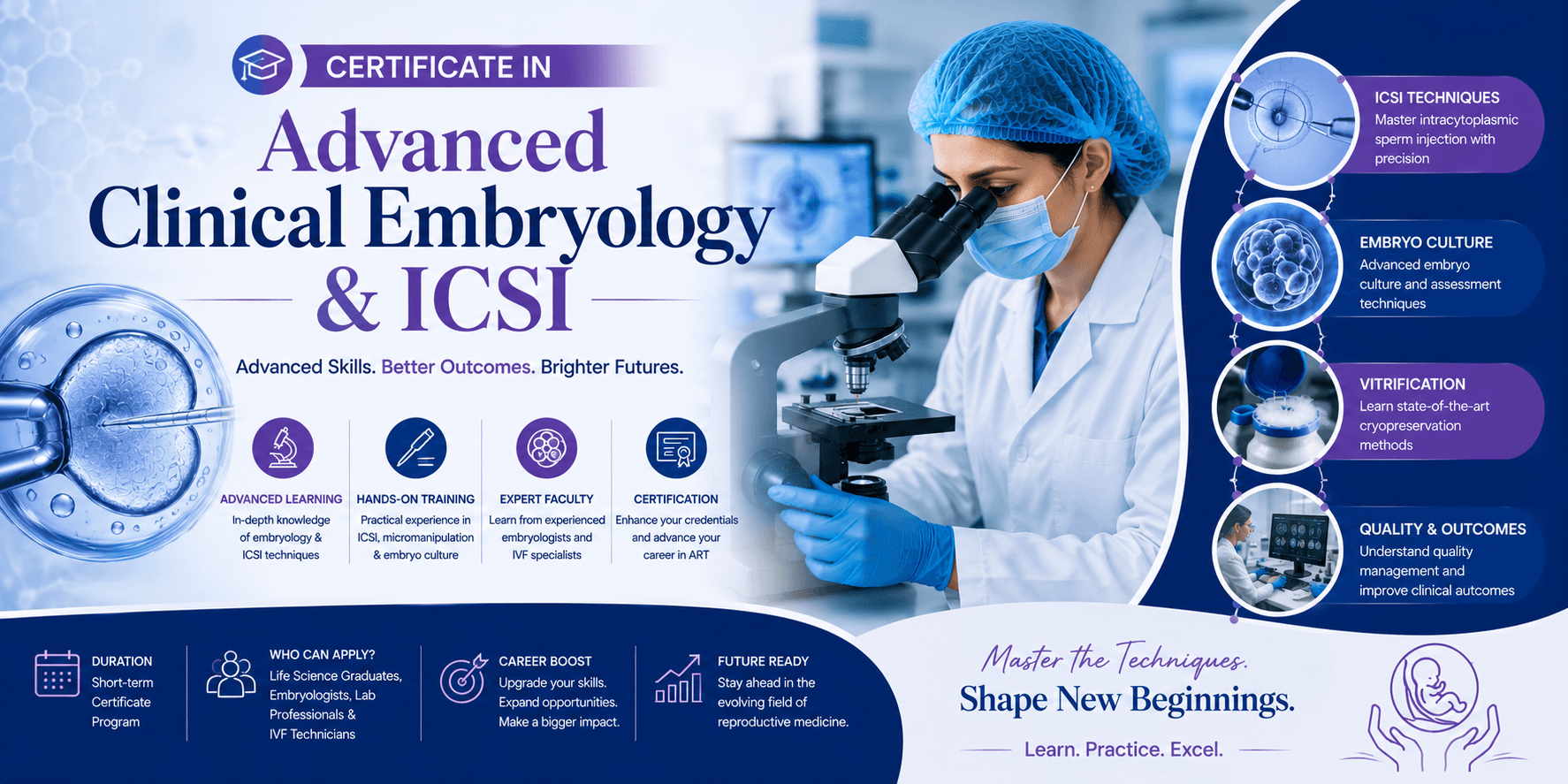
Certificate in Advanced Clinical Embryology & ICSI: Intensive 1-Month Hands-On Training Program
Intracytoplasmic Sperm Injection — better known as ICSI — is the single most important technique in modern IVF. It accounts for over 70% of all fertilization procedures performed globally. For any embryologist, mastering ICSI is not optional — it is the core skill that defines your professional value. The Certificate in Advanced Clinical Embryology & ICSI at RACE is a 1-month intensive program that gives you exactly this expertise.
What Is ICSI and Why Does It Matter?
ICSI is a micromanipulation technique where a single, carefully selected sperm is injected directly into the cytoplasm of a mature oocyte using a fine glass needle (injection pipette) under an inverted microscope with micromanipulators. It was developed in 1992 and has since revolutionized the treatment of male factor infertility.
ICSI is indicated in cases of severe oligozoospermia, asthenozoospermia, teratozoospermia, obstructive and non-obstructive azoospermia (using surgically retrieved sperm), previous IVF fertilization failure, and whenever preimplantation genetic testing requires known fertilization.
Program Structure
- Duration: 1 Month (4 Weeks Intensive)
- Eligibility: BSc/MSc in Life Sciences, MBBS, or working IVF professionals
- Training Split: 80% practical hands-on, 20% theory
- Batch Size: Small groups (max 6-8 per batch) for personalized training
Week-by-Week Training Plan
Week 1: Foundations & Equipment Mastery
Introduction to micromanipulation systems (Narishige/Eppendorf), pipette loading and alignment, equipment calibration, injection and holding pipette setup, and practice on surrogate oocytes. Theory covers oocyte maturation stages (GV, MI, MII), cumulus-oocyte complex assessment, and sperm selection criteria.
Week 2: ICSI Technique Development
Oocyte denudation using hyaluronidase, maturity assessment under the stereomicroscope, sperm immobilization techniques, PVP (polyvinylpyrrolidone) handling, needle loading, and injection practice on practice oocytes. Students perform 50+ injection attempts to build muscle memory and precision.
Week 3: Advanced Procedures
Fertilization check (2PN assessment), embryo culture setup, Day 3 cleavage-stage grading, extended culture to blastocyst, vitrification demonstration, and troubleshooting common ICSI problems (oocyte lysis, failed fertilization, abnormal fertilization). Includes sessions on sperm retrieval sample handling (TESA/PESA specimens).
Week 4: Clinical Integration & Assessment
Observation of live ICSI procedures at partner IVF clinics, complete ICSI cycle simulation from semen prep to fertilization check, quality control documentation, practical assessment, and certificate examination.
Skills You'll Master
- Complete micromanipulator setup, calibration, and troubleshooting
- Oocyte denudation and MII identification
- Sperm selection using morphological criteria
- PVP preparation and sperm immobilization
- Injection pipette loading technique
- Precise ICSI injection with minimal oocyte damage
- 2PN fertilization assessment at 16-18 hours post-injection
- Documentation and quality metrics for ICSI outcomes
Training Equipment at RACE
Students train on professional-grade equipment identical to what is used in top IVF centers: Narishige micromanipulation systems, Olympus IX73 inverted microscopes, Eppendorf CellTram systems, K-Systems heated stages, and Nikon stereomicroscopes for embryo assessment.
Who Should Enroll?
- MSc embryology graduates needing hands-on ICSI practice before their first job
- Working embryologists who learned ICSI on the job and want formal training
- IVF lab technicians looking to upgrade to embryologist-level skills
- MBBS doctors transitioning into reproductive medicine lab work
Career Impact
ICSI-trained embryologists are in the highest demand in the IVF industry. This certificate on your resume signals hands-on competence and can increase your starting salary by 20-30% compared to candidates without ICSI training. Many RACE certificate graduates have been placed within 2 weeks of completing the program.
Content Created By:

RACE Editorial Team
Expert Embryologists