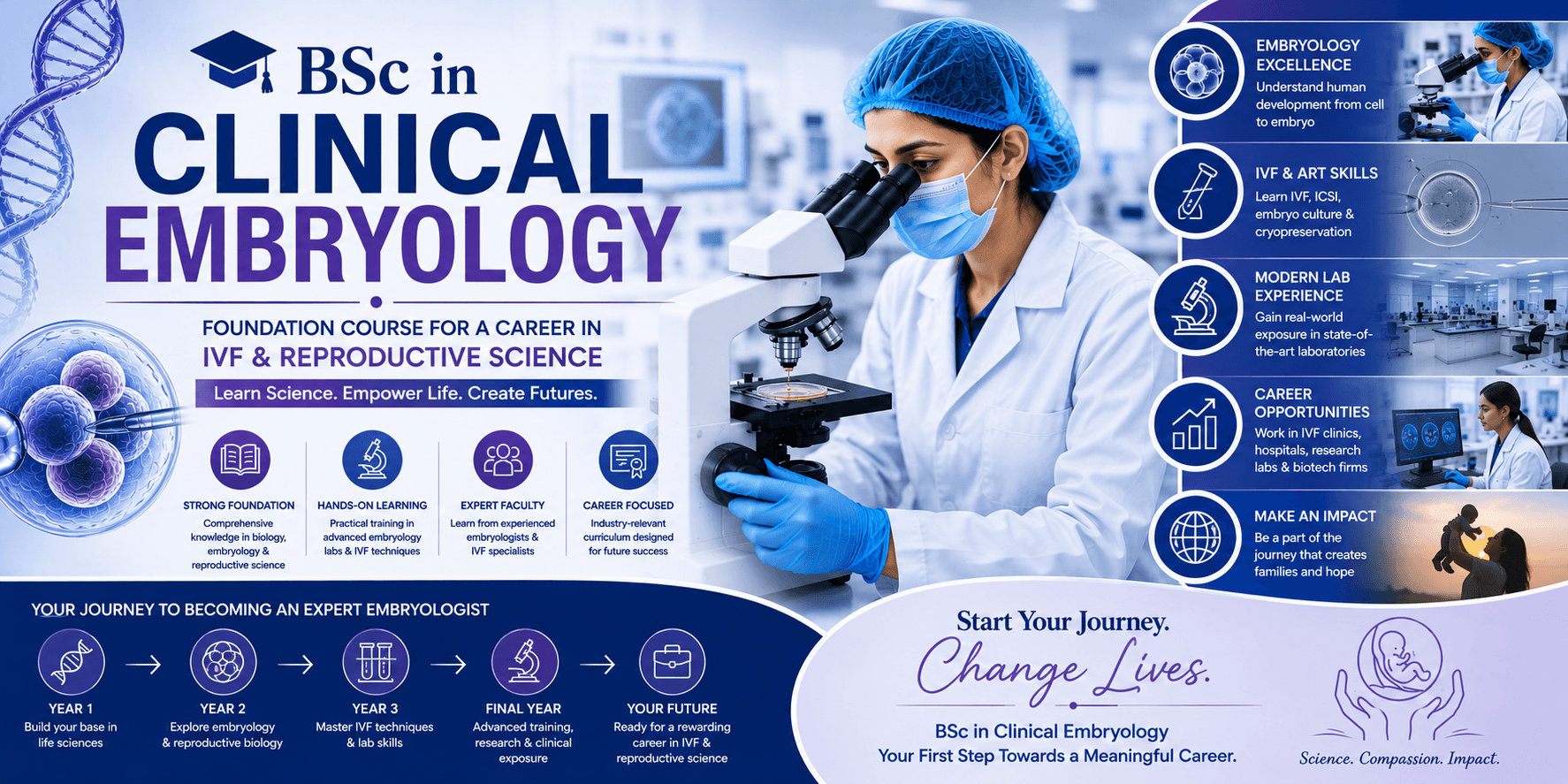
BSc in Clinical Embryology: Foundation Course for a Career in IVF & Reproductive Science
The BSc in Clinical Embryology is a 3-year undergraduate program that gives students a specialized, career-focused education in reproductive science and IVF laboratory techniques. Unlike a generic BSc in Biology or Zoology, this program is laser-focused on the skills and knowledge required to work in the rapidly growing assisted reproductive technology (ART) industry.
Why Choose BSc in Clinical Embryology Over a Regular BSc?
A regular BSc in Biology gives you broad knowledge across multiple disciplines but lacks the specialization needed for direct industry employment. The BSc in Clinical Embryology, on the other hand, combines core life science fundamentals with dedicated embryology coursework and IVF laboratory training from Year 2 onwards. This means you graduate with both a degree and practical skills — making you immediately employable.
Program Details
- Duration: 3 Years (6 Semesters)
- Eligibility: 10+2 with Physics, Chemistry, and Biology (minimum 50%)
- University: Gurugram University (UGC Recognized)
- Unique Advantage: Clinical lab exposure from Year 2
Curriculum Overview
Year 1: Core Sciences
Human anatomy and physiology, biochemistry, cell biology, genetics, microbiology, and biostatistics. Laboratory sessions introduce students to microscopy, staining techniques, and basic lab safety protocols.
Year 2: Introduction to Reproductive Science
Reproductive anatomy and physiology, endocrinology, gametogenesis, semen analysis fundamentals, introduction to IUI and IVF concepts. Students begin hands-on work in RACE's training laboratory, learning semen sample handling, sperm morphology assessment, and basic culture techniques.
Year 3: Applied Embryology & Practical Skills
Embryo development and assessment, cryopreservation basics, IVF laboratory quality control, andrology techniques, assisted hatching introduction, and a supervised practical project. Students also participate in clinical observation sessions at partner IVF clinics.
What Can You Do After BSc in Clinical Embryology?
Option 1: Direct Employment
Graduates can work as junior embryologists, IVF lab assistants, andrology technicians, or medical laboratory technologists at fertility centers and hospitals. Starting salaries range from ₹3-5 LPA.
Option 2: Higher Studies
The BSc serves as a strong foundation for pursuing MSc in Clinical Embryology (2 years), which opens doors to senior clinical positions with significantly higher salaries.
Option 3: Research
BSc graduates can pursue research assistant positions in reproductive biology laboratories at universities and research institutes.
Industry Demand for BSc Embryology Graduates
With over 1,500 IVF clinics operating in India and the number growing annually, the demand for trained laboratory personnel far exceeds supply. BSc Clinical Embryology graduates fill a critical gap as support staff in IVF labs, and many clinics prefer candidates with this specialized degree over generic biology graduates.
Campus Life at RACE
RACE offers a complete learning environment with smart classrooms, a research library with 5,000+ books and digital resources, high-speed Wi-Fi, separate hostels for boys and girls, a campus canteen, and on-campus medical services. The Sidhrawali campus provides a focused, distraction-free setting ideal for academic excellence.
Apply Now
Admissions for BSc in Clinical Embryology (2025-26 batch) are open. Limited seats available. Apply through the online admission form on the RACE website or contact our admissions counselor for guidance.
Content Created By:

RACE Editorial Team
Expert Embryologists